
Blog
Valuing Claude's Anthropic: A Business Valuation Look at Pre-IPO Roth Conversions
A Roth IRA conversion involving pre-IPO shares is a taxable event, and the pre-IPO valuation for Roth IRA conversion purposes sets exactly how much tax you owe today versus what grows tax-free later. This guide walks through the market, income, and asset approaches appraisers use, and explains why funding-round pricing or rumored IPO prices can't substitute for a defensible fair market value.
Valuing Claude's Anthropic: A Business Valuation Look at Pre-IPO Roth Conversions
Converting privately-held, pre-IPO stock into a Roth IRA is a taxable event like any other Roth conversion, but the mechanics get complicated fast. There's no closing price to pull, no ticker to check, and the number a qualified appraiser assigns on the conversion date becomes the taxable amount you report to the IRS this year. Get that fair market value wrong, in either direction, and you've either overpaid tax on value that doesn't exist yet or set up a number the IRS can challenge for years afterward.
Why the Conversion Date Sets Your Tax Bill
When you convert assets from a traditional IRA (or from after-tax contributions) into a Roth IRA, you owe ordinary income tax on the fair market value of whatever you convert, measured on the date of conversion. The IRS's guidance on valuing plan assets applies the same willing-buyer, willing-seller standard used across the tax code: the price at which the property would change hands between a hypothetical willing buyer and willing seller, neither under compulsion, both reasonably informed.
For cash, mutual funds, or publicly traded stock, that's a non-event. You pull the closing price and move on. For a block of common stock in a company that hasn't gone public, there is no price to pull.
Custodians still carry a reporting obligation. They report year-end fair market value on Form 5498 and report the conversion itself on Form 1099-R, and general IRS guidance on valuing assets makes clear that hard-to-value, non-publicly-traded holdings need a real valuation behind that number, not a placeholder. When the asset is illiquid, closely held stock, the custodian has no independent way to price it either. That obligation lands on you and whoever you hire to appraise the shares. That's the role our business valuation services exist to fill.
What Makes Pre-IPO Equity Hard to Price
Pre-IPO equity is what appraisers call closely held stock: shares in a company with no active public market, typically carrying transfer restrictions such as rights of first refusal, board approval requirements, or lock-up provisions that prevent a holder from simply selling on the open market. Those restrictions matter because fair market value assumes a hypothetical sale could actually happen, and for closely held stock, it can't happen freely.
A useful way to picture this category is the wave of high-growth, privately-held artificial intelligence companies that have raised money at large valuations while staying private well past the point where an earlier generation of tech companies would have gone public. Anthropic, the maker of the Claude models, is a widely discussed example of this type of company purely because it's currently in the public conversation. To be direct about it: we have no relationship with Anthropic, we have never appraised Anthropic shares, and nothing in this article states or implies what Anthropic's shares are actually worth. It's used here only to make an abstract category, illiquid, high-growth, privately-held, pre-IPO stock with no public market price, concrete for readers who are trying to picture what "closely held equity" means in practice.
Key takeaway: self-directed IRAs increasingly hold founder or early employee equity in exactly this kind of company, and that combination (a hard-to-price asset inside a tax-advantaged account) has drawn real IRS and regulatory attention because an undervalued conversion can shift enormous future gains into tax-free territory.
The Three Approaches We Weigh for Illiquid, Pre-IPO Shares
Appraisers don't default to a single formula for closely held stock. The foundational federal guidance on valuing shares without a public market calls for weighing all relevant factors, including the nature of the business, its economic and industry outlook, book value and financial condition, earning capacity, dividend-paying capacity, goodwill, any prior sales of the stock itself, and the prices of comparable public or private companies, rather than mechanically applying one number. We walk through this same weighing process in more depth in our breakdown of the three approaches to valuing a business, and it applies directly to pre-IPO equity held inside an IRA.
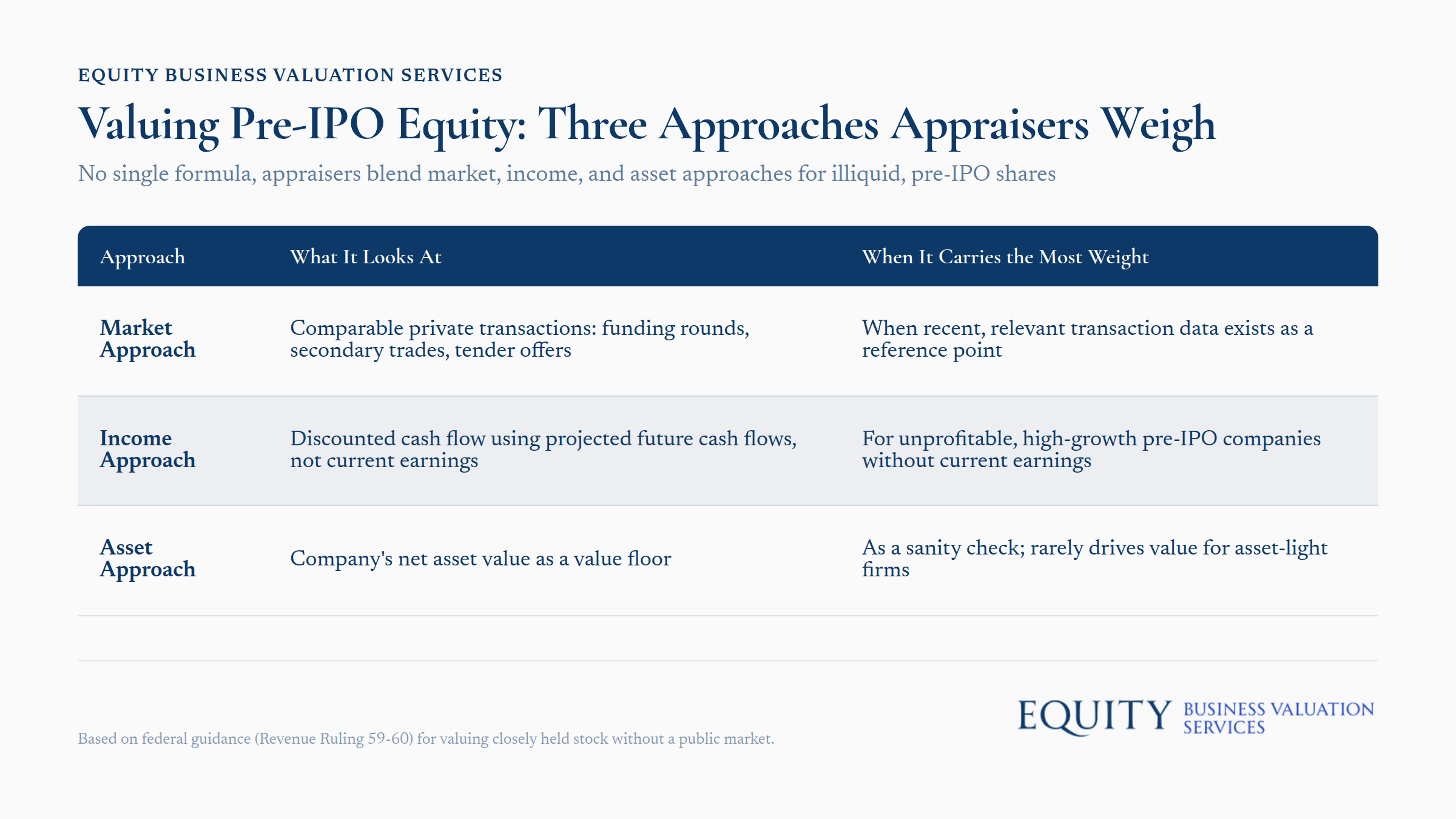
In practice, that weighing process draws on three approaches:
- Market approach: we look at comparable private transactions, including recent priced funding rounds, secondary market trades, and tender offers, and treat them as data points about value rather than as the value itself.
- Income approach: for companies that aren't yet profitable, which describes most high-growth pre-IPO companies, we build a discounted cash flow analysis using projected future cash flows instead of current earnings, then discount those projections back to present value.
- Asset approach: we check the company's net asset value as a floor. For an asset-light software or AI company, this approach rarely drives the conclusion, but it's a useful sanity check against an overly optimistic income or market number.
The same closely-held-stock reasoning shows up in how we handle other illiquid ownership interests. Our analysis of how appraisers apply Revenue Ruling 59-60 to limited partnership interests covers the same underlying framework from a different angle.
Why the Last Funding Round's Price Isn't Your Roth Conversion Value
A funding round price is one data point in the market approach. It is not the fair market value of your specific shares, and treating it as one is the single most common mistake we see in self-directed IRA valuations of pre-IPO stock.
There are three reasons a funding round number needs adjustment, not adoption:
- Share class matters. Investors in a priced round almost always buy preferred stock with liquidation preferences, anti-dilution protection, and other rights that common stock (the kind most founders and early employees hold) doesn't carry. Preferred and common are not interchangeable dollar for dollar.
- Time elapsed matters. A round priced 18 months ago reflects conditions at that time, not conditions on your conversion date. Markets, company performance, and capital availability all move.
- Marketability and control matter. An individual holding a minority block of common stock in a private company faces real discounts for lack of marketability (DLOM) and, depending on the position, lack of control (DLOC), because there is no market to sell into and no ability to force a liquidity event.
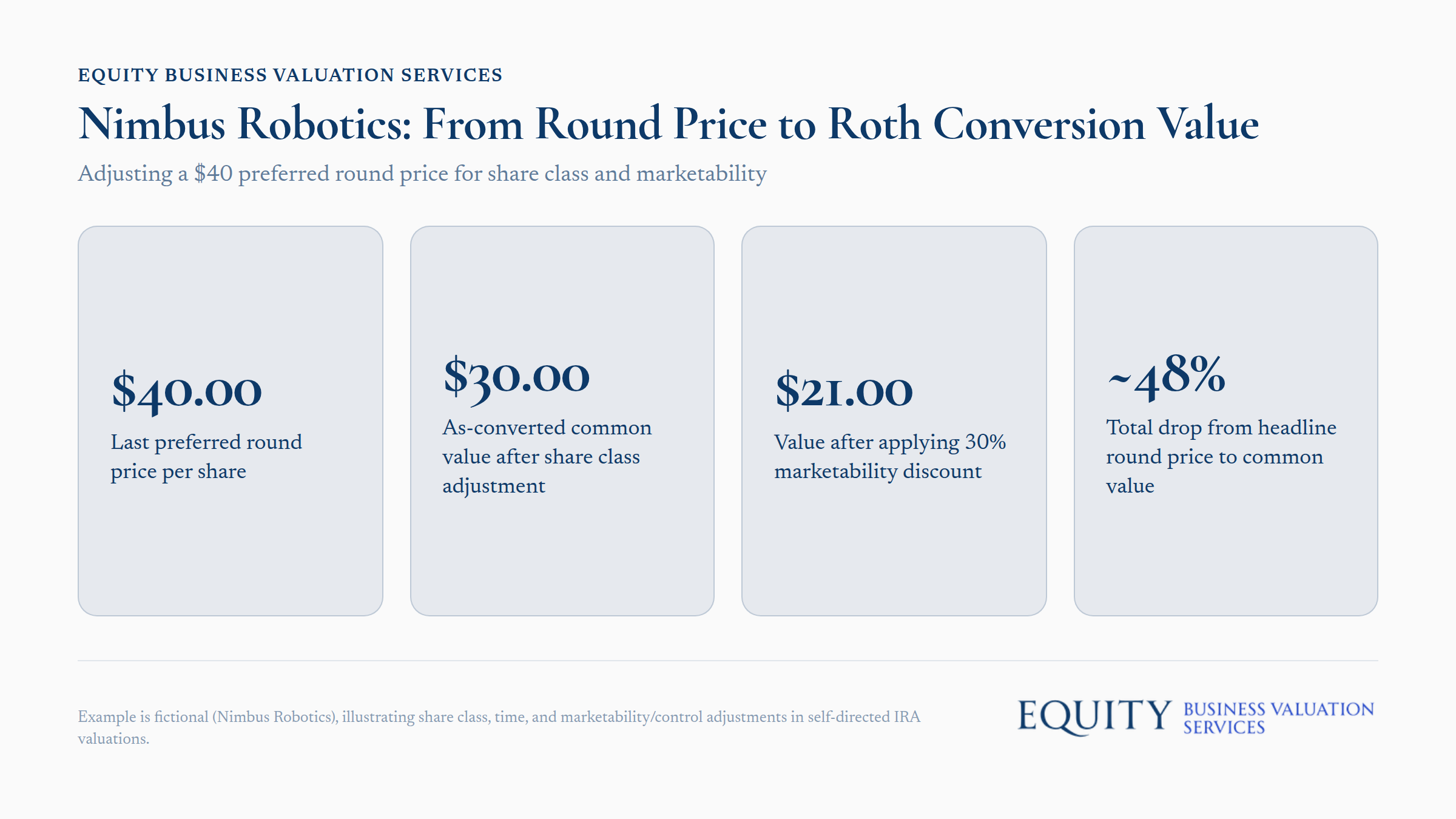
Example: Say a fictional company we'll call Nimbus Robotics closes a preferred financing round at $40.00 per share, implying a $2.4 billion post-money valuation. An early employee holds common stock, not preferred. Adjusting for the difference in rights between the two share classes (the preferred stack sits ahead of common in any exit) might bring the as-converted common value down to roughly $30.00 per share before any discount is applied. Layer on a marketability discount in the 20% to 40% range, typical for stock with no near-term path to liquidity, and a 30% DLOM brings that same share to about $21.00. That's roughly half the headline round price, on the same underlying company, because of factors the round price alone never captures.
Watch out: using the flat post-money-per-share number from the last round as your Roth conversion value, without adjusting for share class or applying a marketability discount, is a red flag for exactly the kind of scrutiny self-directed IRA valuations attract.
Rumored IPO Pricing Is Not Fair Market Value on Your Conversion Date
A rumored or anticipated IPO price cannot stand in for fair market value on your conversion date, and this is worth stating plainly because it's the second most common mistake we see. The willing-buyer, willing-seller standard is forward-looking about the property being sold, but it's not forward-looking about the price. It asks what a hypothetical transaction would fetch today, on the actual valuation date, given information available at that time.
"Fair market value is the price at which the property would change hands between a willing buyer and a willing seller, neither being under any compulsion to buy or sell and both having reasonable knowledge of relevant facts." - IRS guidance on valuation of plan assets
An expected future IPO price is speculative by definition. It depends on market conditions, investor sentiment, and company performance between the conversion date and the eventual offering, none of which are knowable with certainty on the day you convert. Building today's valuation around tomorrow's hoped-for number inverts the standard the IRS actually applies.
Pro tip: if your company has filed confidentially or is in a pre-IPO quiet period, that context can be relevant background information for an appraiser weighing market conditions, but it still gets folded into the analysis as of the conversion date, not treated as a substitute for it.
Why an Independent, USPAP-Compliant Appraisal Matters Here
A self-prepared number or an informal estimate from a company's finance team doesn't carry the same weight as an independent appraisal when the IRS looks at a Roth conversion involving illiquid stock. Reports prepared in accordance with the Uniform Standards of Professional Appraisal Practice (USPAP), published by The Appraisal Foundation, document the methodology, the data considered, and the reasoning behind the concluded value, which is exactly what stands up to scrutiny years after the fact.
Our appraisers hold credentials with organizations including the American Society of Appraisers (ASA) and the National Association of Certified Valuators and Analysts (NACVA), and every business valuation engagement we take on is built to the same standard regardless of whether the underlying asset is a family business, a partnership interest, or pre-IPO equity headed into a retirement account. Because these engagements are quoted as a fixed fee after we scope the assignment (based on the complexity of the company, the completeness of the available financial and cap table records, and the depth of analysis the intended use requires), you know the cost before work begins. Fees are never based on the value the appraisal concludes.
Getting the Number Right Before You Convert
A Roth conversion of pre-IPO stock only happens once at a given fair market value, and that value follows you for the life of the account. The right process weighs comparable transactions, builds out an income approach where earnings aren't yet steady, checks the asset floor, and then applies the discounts a real minority, illiquid position actually carries, rather than copying a funding round number or guessing at a future IPO price. If you're holding closely held or pre-IPO shares inside a self-directed IRA and considering a Roth conversion, our team can scope and prepare a defensible valuation before you make that decision.
This article is provided for general informational purposes only and does not constitute legal, tax, or financial advice. Readers should consult a qualified attorney or CPA regarding their specific circumstances.