
Blog
Who Bears the Burden of Proof in an IRS Gift Valuation Audit?
In most IRS gift valuation audits, the burden of proof in an IRS gift valuation dispute starts with the taxpayer. This guide walks through the three specific moves, adequate disclosure, a qualified appraisal, and credible evidence under IRC 7491(a), that can shift it to the government.
The Default Rule: the Taxpayer Bears the Burden of Proof
When a business owner gifts an interest in a family LLC, an S corporation, or a partnership, and the IRS later disagrees with the value reported on Form 709, the taxpayer starts the fight from behind. A notice of deficiency is presumed correct under longstanding Tax Court precedent, which means the person who reported the gift, not the IRS, generally has to prove that number wrong by a preponderance of the evidence.
That default matters because closely held business interests are exactly the kind of asset the IRS scrutinizes most. There's no public trading price to point to, valuation relies on discounts, projections, and comparable transactions, and reasonable appraisers can land in different places on the same set of facts. If the IRS opens an audit and the taxpayer has nothing more than a number on a return, the deficiency notice wins by default.
The rest of this guide covers the two things that change that outcome: getting the statute of limitations to close the door on the audit in the first place, and building a record strong enough to flip the burden onto the IRS if the matter ends up in court.
Our business valuation for gift tax team builds reports around exactly this framework, because a valuation that only supports a number is not the same as one built to survive a challenge.
Adequate Disclosure: the Regulatory Trigger for the 3-Year Clock
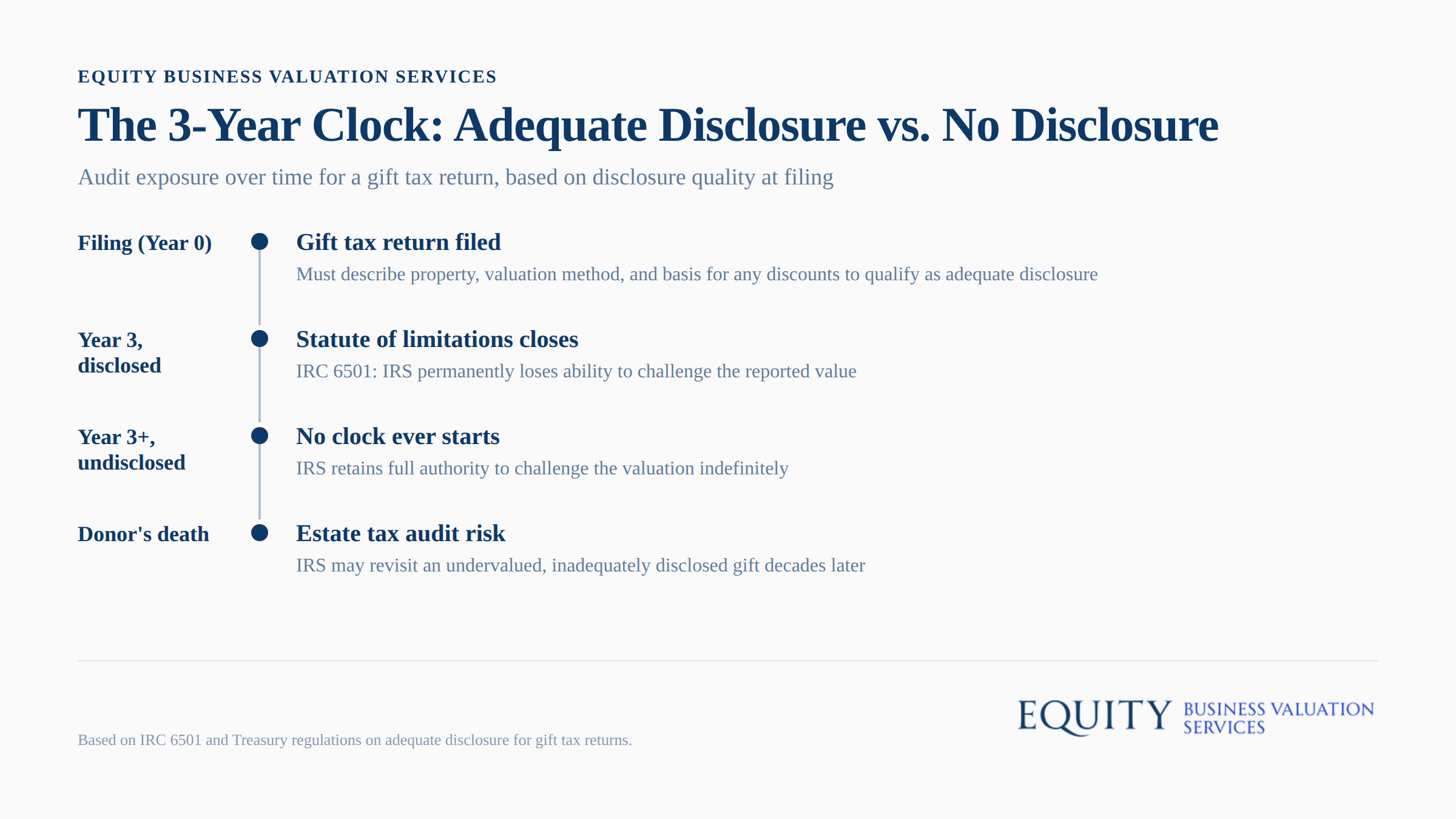
Adequate disclosure does not itself shift the burden of proof. What it does is start the 3-year statute of limitations on assessment under IRC 6501, so the IRS loses the ability to challenge the reported value at all once that window closes.
Without adequate disclosure, there is no clock. The IRS can revisit the gift's value years later, sometimes at the donor's death, when it audits the estate tax return and finds the earlier gift undervalued. That single fact is why disclosure quality matters as much as the appraisal conclusion itself.
Treasury regulations set out what a gift tax return has to include to qualify as adequately disclosed. At minimum, that means:
- A description of the transferred property, including the type of interest, the entity's formation documents, and the donor's percentage before and after the gift.
- The method used to determine fair market value, along with the financial data and projections the method relied on.
- The basis for any discounts claimed, such as lack of control or lack of marketability, and how those discounts were quantified.
- Any other information the regulations require to give the IRS a fair opportunity to evaluate the reported value without further inquiry.
A return that checks these boxes locks in the 3-year window. One that reports a bare number with a discount percentage and no supporting detail leaves the door open indefinitely, regardless of how accurate the underlying appraisal turns out to be.
What a Qualified Appraisal Must Show Under the Disclosure Regulations
Adequate disclosure of a gift valued using an appraisal carries its own, more specific set of requirements. The appraisal attached to the return has to meet content and independence standards, not just arrive at a defensible number.
The regulations expect the appraisal to document:
- Appraiser qualifications and independence: a statement of the appraiser's credentials and confirmation that the appraiser is not the donor, the donee, a family member, or anyone with a financial stake in the outcome.
- A detailed description of the interest: the entity type, governing documents, and the specific rights (or restrictions) attached to the transferred interest.
- The valuation methodology: which approach was used (income, market, or asset-based), the assumptions behind it, and the data relied upon.
- The specific basis for any discounts: comparable studies, restricted-stock data, or other market evidence supporting a discount for lack of control or marketability, not just an asserted percentage.
- The appraisal date and effective date: signed, dated, and completed close enough to the gift date to reflect the actual transfer.
Our appraisers hold credentials with organizations such as the ASA and NACVA, and independence from the donor and donee is treated as a hard requirement on every gift tax engagement, not a formality.
Adequate Disclosure vs. a Merely Competent Appraisal
Many appraisals are competent enough to support a reasonable value opinion but still fall short of what the disclosure regulations require. The gap usually shows up in documentation, not in the conclusion itself.
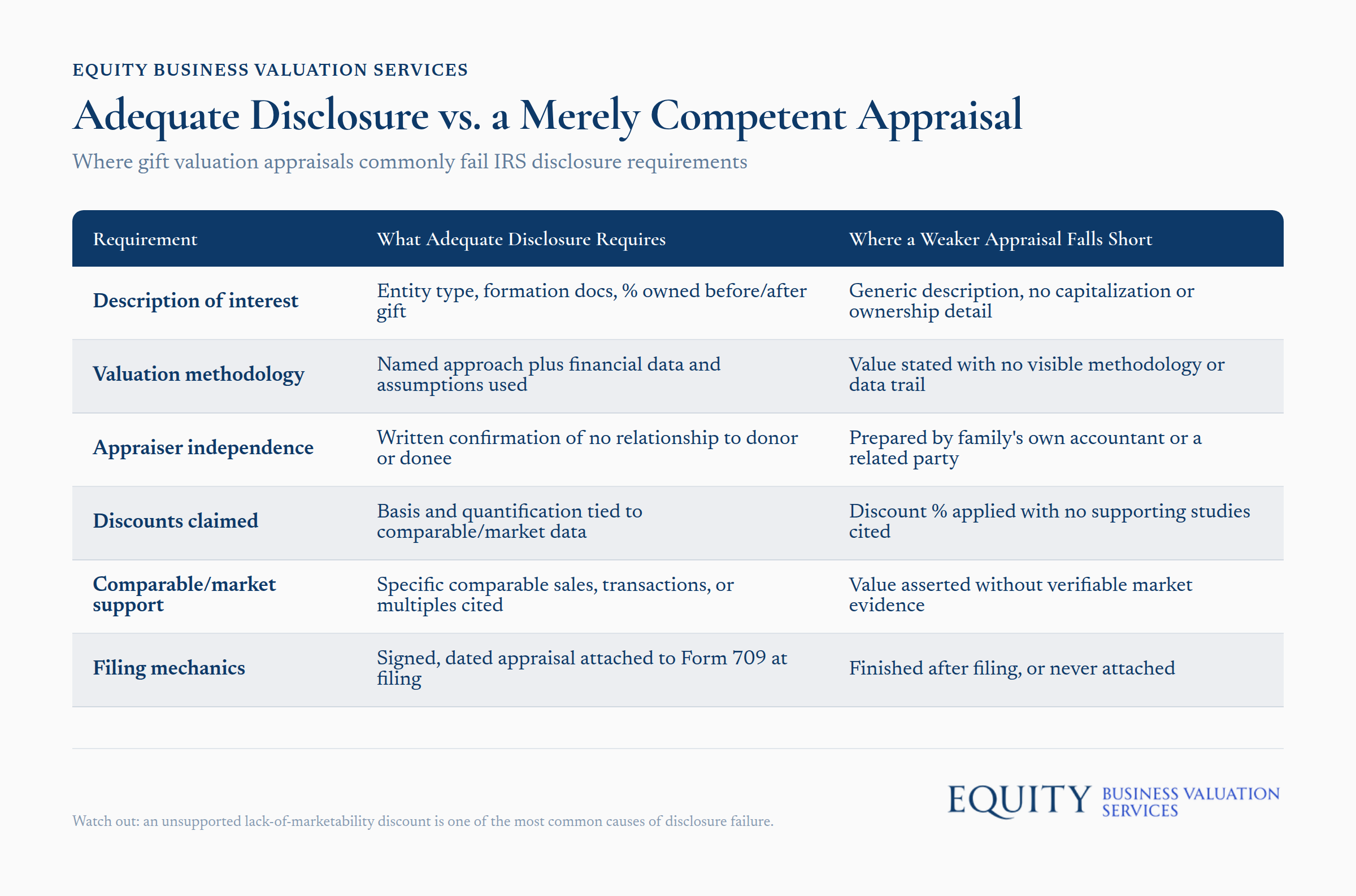
The table below compares what the disclosure rules actually require against where a weaker appraisal commonly falls short.
| Requirement | What Adequate Disclosure Requires | Where a Weaker Appraisal Falls Short |
|---|---|---|
| Description of the interest | Entity type, formation documents, percentage before and after the gift | Generic description with no capitalization or ownership detail |
| Valuation methodology | Named approach plus the financial data and assumptions used | A value stated with no visible methodology or data trail |
| Appraiser independence | Written confirmation the appraiser has no relationship to donor or donee | Appraisal prepared by the family's own accountant or a related party |
| Discounts claimed | Basis and quantification, tied to comparable or market data | A discount percentage applied with no supporting studies cited |
| Comparable or market support | Identification of specific comparable sales, transactions, or multiples relied on | Value asserted without citing verifiable market evidence |
| Filing mechanics | Signed, dated appraisal physically attached to Form 709 at filing | Appraisal finished after the return is filed, or never attached |
Watch out: A discount for lack of marketability that isn't tied to specific comparable data is one of the most common reasons an otherwise reasonable gift valuation fails to qualify as adequately disclosed.
IRC 7491(a): When the Burden Shifts to the IRS in Litigation
If a gift valuation dispute reaches Tax Court, IRC 7491(a) can shift the burden of proof on a factual issue, including valuation, from the taxpayer to the IRS. This only applies to examinations that began after July 22, 1998, and it is not automatic.
According to IRS Publication 556, the taxpayer has to satisfy four conditions before the burden shifts:
- Introduce credible evidence on the valuation issue, meaning evidence a court would find sufficient to base a decision on after weighing it critically.
- Comply with all substantiation requirements in the Code for the item at issue.
- Maintain all records the Code requires to be kept.
- Cooperate with reasonable IRS requests for information about the return and its preparation.
For gifts of entity interests specifically, there is a fifth hurdle. If the taxpayer is a corporation, partnership, or trust, the entity must have a net worth of $7 million or less and no more than 500 employees at the time the liability is contested in court. A large family holding company or an operating partnership that exceeds that threshold does not get the benefit of 7491(a), even if every other condition is met.
Key takeaway: A qualified appraisal that meets the disclosure regulations does double duty. It starts the statute of limitations running at filing, and if the audit still ends up in litigation, it is the primary evidence that can satisfy the "credible evidence" requirement under 7491(a).
What Courts Have Said About Credible Evidence in Valuation Disputes
Courts don't take an appraiser's conclusion at face value just because a report exists. In gift and estate valuation litigation, including the Eighth Circuit's decision in Griffin v. Commissioner, 315 F.3d 1017 (2003), judges have scrutinized whether the taxpayer's valuation evidence was thorough, independent, and grounded in verifiable market data, or whether it looked more like advocacy dressed up as analysis. The broader body of gift and estate valuation cases sometimes discussed under the shorthand of the Estate of Jones line of commentary reflects the same theme: a report that shows its work tends to be treated as credible, and one that doesn't tends to lose that status regardless of the number it reaches.
The presumption of correctness protecting the IRS's own valuation isn't absolute either. Commentary on gift tax valuation appeals notes that the presumption can fall away when the IRS's assessment is shown to be "excessive and arbitrary" or "utterly without foundation". Once a taxpayer makes that showing, the Tax Court has to determine the correct value itself rather than simply defaulting to the IRS's number. None of this guarantees a favorable outcome in any individual case; it describes the standard courts apply when weighing competing valuation evidence.
Separately, the government carries its own burdens in specific situations. The IRS's estate and gift tax examination procedures note that the IRS bears the burden of proving civil fraud in Tax Court by clear and convincing evidence, and courts have held that when the IRS raises a new valuation theory after a taxpayer has already filed a Tax Court petition, the burden on that new issue falls on the government, not the taxpayer.
Practical Takeaways for Family LLCs, S Corps, and Partnership Gifts
For a business owner planning to gift interests in a family LLC, an S corporation, or a partnership, the sequence that protects the gift looks the same in almost every case.
Example: A family gifts a 15% non-controlling interest in an operating LLC to the next generation. The return reports the interest at $1.2 million after a 30% combined discount for lack of control and marketability. If the return simply states the discount percentage, the IRS can reopen the value years later at the donor's death. If the return attaches an appraisal that documents the entity's structure, the income approach used, the specific restricted-interest studies supporting the 30% discount, and the appraiser's independence from the family, the 3-year clock starts running at filing, and if the IRS challenges it anyway, that same report is the evidence that can move the burden of proof back onto the government.
Owners planning gifts of S corporation stock or partnership and LLC interests face the added complexity of entity-level tax treatment and discount methodology layered on top of the disclosure rules, which makes a documented, independent appraisal even more important than for a simple cash gift.
Getting this right is a documentation exercise as much as a valuation exercise. The appraisal has to reach a defensible number, but it also has to be built, from the first page, to meet the specific content and independence standards the disclosure regulations demand. Our valuation team scopes every gift tax engagement with both goals in mind, so the report does its job whether the IRS accepts the return as filed or the matter ends up in front of a judge.
This article is provided for general informational purposes only and does not constitute legal, tax, or financial advice. Readers should consult a qualified attorney or CPA regarding their specific circumstances.